As I’m sure anyone who’s studied literature can tell you, it’s very easy to get tunnel vision. Having realised that I was doggedly reading fiction that would be considered ‘literary’, I decided to branch out a bit. Here’s what I’ve enjoyed recently.
And yes, I know there are folks out there who will take issue with my using the pigeonhole subheadings ‘literary’ and ‘fiction’, and that many pieces of writing have elements of these. I’m not arguing. But please. You let me get on with writing a blog, and I’ll let you get on with writing a postredeconstructionist piece on Djuna Barnes’ use of the letter ‘m’. Okay, cheers.
The Psychopath Test, by Jon Ronson
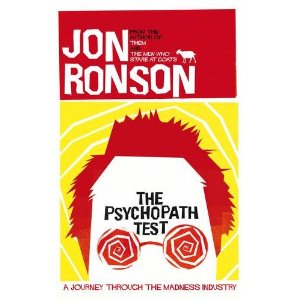
Amateur sleuthery at its best. What I like about Jon Ronson is his enthusiasm. Whereas most folk would see something interesting and leave it at that, Ronson decides to pursue until all the loose ends are as neatly tied up as possible.
What starts out as a whodunnit about a mysterious handmade book sent to a few dozen academics quickly becomes an investigation into the nature of mental illness, namely psychopathy. Over the course of the book he meets with a number of psychopaths, psychiatrists, and Scientologists (!), each with their own take on the nature of psychopathy.
His enthusiasm for intrigue is infectious, and his storytelling is gripping. I defy you to finish reading this without looking around your social circles, trying to work out if any of your associates are psychopaths.
Hokkaido Highway Blues, by Will Ferguson
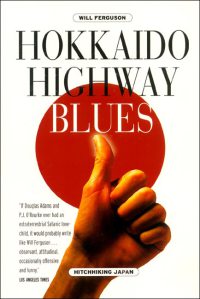
Travel writing is a particular bugbear of mine. All too often, it takes what can be conveyed succinctly and overloads the sentence with innumerable adjectives and subclauses.
Whereas a normal writer may come out with something like: The trees were a beautiful shade of green.
The travel writer is likely to produce this: The trees, evergreen against the stark deciduous backdrop of my weary traveller’s mind, shimmered, like effervescent emeralds, in the sky– Lucy can keep her sky of diamonds, I have my sky of emeralds; those trees were more alive than most people, especially those that haven’t had a gap year.
That kind of writing isn’t big, and it certainly isn’t clever. That’s why Will Ferguson is a breath of fresh air.
Witty, self-deprecating, and wonderfully written, his images succeed in being evocative without being pretentious. Ironically, this is one instance where flowery language would have been acceptable, seeing as he is documenting following the sakura (the annual fall of the cherry blossoms) from the South of Japan to the Northernmost point.
How does he travel? By hitchhiking. That’s right: in the land of bullet trains, he decided to pitch his thumb and see what happened. Cue the world-famous helpful nature of the Japanese people, a phenomenon I experienced first-hand.
Yet he is also unafraid to write critically of his host country, a rarity in a genre that often worries about appearing imperialistic. Particularly striking are his discussions of the systemic isolation and exclusion that a gaijin (foreigner/outsider) in Japan can expect to experience, despite the country believing it is not racist. A country that condemns America’s treatment of black people, but has no qualms about game shows that routinely humiliate foreigners. Ferguson’s relationship with Japan is as love/hate as they come.
At its heart, this is a book about momentum and ambivalence. It’s ruddy good.
Freakonomics, by Steven D. Levitt & Stephen J. Lubner
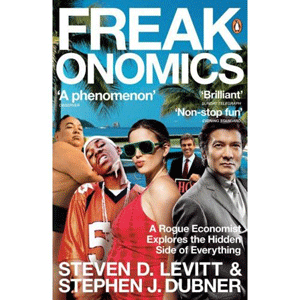
I know I’ve missed the boat by about five years on this one. However, if there is anyone who has yet to read this, then I really recommend it.
Economics is often regarded as quite a narrow field of study. However, this book shows that the methodology can be used to analyse a number of social situations. What incentives are there for teachers and sumo-wrestlers to cheat? Why do most crack dealers still live with their mums? Freakonomics is able to analyse and interpret these scenarios in terms of incentives and provides some pretty startling conclusions.
It does have a tendency to ascribe causal relationships when really there are correlations, but I imagine this has a lot to do with making the book as punchy as possible. Something to keep in mind.