Little known fact: you can download all of the data that constitutes ‘your’ Facebook. I discovered this when idly browsing through Facebook’s privacy settings. With all of the privacy concerns surrounding the internet at the moment, I decided to take a gander. Some of it was unnerving, especially the fact that they’ve kept some messages that I thought I had deleted years ago.
I’m not interested in making Facebook look like some evil giant waiting to enslave us, as some would have us believe. To their credit, they’ve made downloading your data very straightforward. Just click on ‘Account’, and ‘Account Settings’. About three quarters of the way down this page, you’ll find the following link:

You are then presented with a security prompt where you will need to input your password again. It also warns you about keeping this data secure:
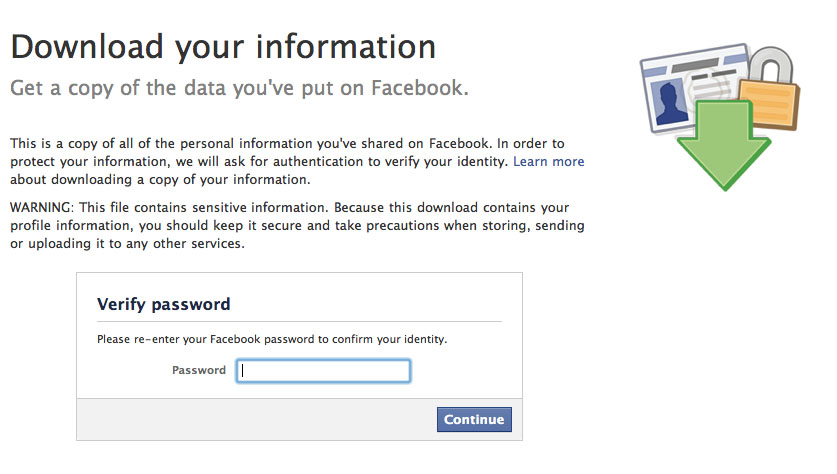
It takes a couple of hours for them to prepare your information, and then you’ll receive an email link once it is ready to download.

229 megabytes later and it was in my Downloads folder.
I’ve had a thorough look through my Facebook folder. Firstly, it’s worth noting that it doesn’t have everything that you’ve ever put up on Facebook. It has every post on your wall, every status, every photo and video you’ve uploaded, and every message that you have sent and received.
The folder doesn’t contain any photos that you have been tagged in, or any comments that you’ve left outside of your wall. So, in reality, the folder is a small part of what I’ve placed on Facebook over the years. But what is here is very interesting.
As well as all of the photos and videos I’ve uploaded to Facebook, the folder comprised of a number of HTML files.
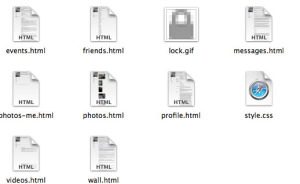
Having opened one, I was able to navigate between them using the handy links on the left hand side of each of the pages. Well done to Facebook for putting the effort in to make this as user-friendly as possible, it’s a good step towards transparency; something they haven’t been particularly brilliant with in the past.
Having fun with my past
First up was my profile page, which listed every group that I’m signed up to:

I need to have a tidy up.
This isn’t the full list, but already it shows a lot about me. You can see that I have left-wing political views. You can see that I like joining groups with funny titles. You can also see that I politely join pages for various charity fundraising efforts, even if I barely know the person who invited me.
But what I really wanted to look at was my complete Wall. This is four and a half years’ worth of what I have been thinking, feeling, linking, and what my friends have been talking to me about. The HTML file itself was 2.1 MB, which is huge, considering that it’s just a load of code– no photos or other similarly data intensive objects– just code.

I imagine that this startling fact will be met with an indifferent shrug by most.
Crudely timing it with my phone’s stopwatch, it took roughly 42 seconds for my computer to fully load everything. Bear in mind that the file was already on my hard drive, so it wasn’t a case of having a slow connection. It took 42 seconds for my fairly decent computer to process the sheer mass of HTML that I’d thrown at it.
I scrolled back. All the way back. Had I a sharper wit, I’d have probably played some music from Back to the Future while I scrolled. It was interesting how many more exclamation marks, swear words, and emoticons I used when I was younger and more enthusiastic. I could probably plot a graph showing how these have diminished as time has gone on, but I’m a humanities graduate and I’d probably do it wrong.
I kept going, right back until I found my very first status. It tied in with the very first essay that I was writing at university:

You may be wondering why there is no verb in my status. Well, back when you needed a university email address to sign up to Facebook, every status automatically started with the word ‘is’. It was a creative renaissance for grammatical workarounds.
I then decided to look at my messages. That was much more unnerving.
Facebook, why have you kept these?
I looked back through my messages, knowing that I’d had a clearout two, maybe three, years ago. More recent messages that I’ve deleted weren’t there, but for some reason I had messages going all the way back to 2006. Some of these were personal, such as a message from a friend when my Gran died a few years ago.
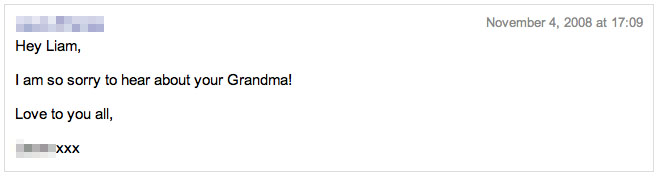
This wasn’t in my inbox any more. Why was it here? I was pretty angry. And worried. Were Facebook storing information that was deeply personal to me, even against my wishes? Facebook is, in essence, a business model which makes money through data mining. But as Venessa Miemis eloquently argued, we should be able to control what data they keep.
More recent items I’d deleted had vanished. Why not the older messages?
The answer, fortunately, was much less sinister than I thought: there were still copies of all these messages in the ‘Sent’ box, all the way back to 2006. Even though I had deleted what my friends had sent to my inbox, their messages remained in the ‘Sent’ threads because I had responded to them. Interestingly, however, the response that I sent to my friend didn’t show in the backup file, but it was there online in the ‘Sent’ folder. I suppose a massive entity like Facebook has to have some gammy limbs here and there.
As a test, I deleted some of these old sent messages to see if they would still linger on. I’ll have to get back to you about whether they’ve finally disappeared as Facebook will only let me download the same backup that I downloaded yesterday– probably a way of conserving resources.
I do it to myself. I do. And that’s what really hurts.
A scenario: somebody obtains my password. I use the same one for my Facebook and my email account. This person downloads all of the information on my Facebook. Back in 2008 a friend wanted to make a payment into my bank account, and messaged me with my sort code and account number to confirm them. I replied that the details were correct, told them off for sending such details over a social network, and then deleted my friend’s message from my inbox.
Because I replied to my friend’s message, my bank details still remained in a thread in the ‘Sent’ folder. They are there for my data thief to use at their leisure. Two days after my information has been downloaded, my bank statement is full of purchases of Eastern European DVDs showing donkeys doing unspeakable things to men.
While Facebook seem to have sorted this out for more recent messages, they haven’t done this retroactively. Something like this is possible.
Perhaps I’m overreacting. But as the recent Sony fiasco has shown, our data is valuable and people will go to great lengths to obtain it. Since I downloaded my Facebook history, I have been more aware of just how much of my information is out there. Putting yourself online is easy; trying to rein your information in– that’s another matter entirely.
Following the furore a few years ago when they tried to claim exclusive and everlasting ownership of any content you uploaded, Facebook have toned it down. Their Privacy Policy now states that any deleted content will be deleted from their servers after 90 days:

Their terms now state that they will only claim intellectual property rights for as long as you are a member:

Though they could still claim ownership if your content has been shared, which, I imagine, would be most stuff. Bit dodgy.
The bit about sharing aside, Facebook have made a real effort to be transparent. Their terms and privacy policy are easy enough to read, and the fact that they allow you to painlessly download your data (or at least some of it) is a step in the right direction.
Facebook make it clear that they won’t keep data long after you delete it, but actually deleting it is rather difficult.
Groups are a perfect example. In order to delete a group that I created, I would have to manually kick out every member before Facebook gives me the option to delete the group. And have you ever noticed that there’s no easy way to delete several of your wall posts or friends at any one time? The only way to do it is to delete them individually. My wall posts go all the way back to 2006; trying to delete them all would take forever, and there’s no option for Facebook to automatically delete wall posts after a certain length of time.
Nor is it easy for other people to access this information. If anyone wanted to see my 2006 wall posts, they would be clicking ‘Older Posts’ for a very long time. Plus it would probably hang after a few clicks, and you’d be stuck with the ‘three bars of indefinite loading time’ at the bottom of my profile page until you clicked refresh and started again:

Couldn’t even take a screen cap of all three of them at one. Damn you, three bars of indefinite loading time…
That’s how Facebook likes it. It relies on having our data online. It is what enables it to be a successful ad platform and data miner. They don’t want us deleting our data because data is makes them their money, hence why it takes forever to delete anything.
On the other hand, deleting an entire profile is a chore as well. It would ensure that all of your data got wiped, but it would still take ages if you still wanted to be connected to everyone. You would either have to start from scratch with a new account, or painstakingly collect the contact information of everyone who you wanted to stay in touch with.
When it comes to my information, Facebook has me over the barrel. I willingly placed all of that content up there– that was easy enough– getting it down isn’t going to be anywhere near as straightforward.