Nara really is a beautiful place. A ten minute walk through a somewhat ordinary looking Japanese city and suddenly you’re surrounded by deer. Yes, deer:
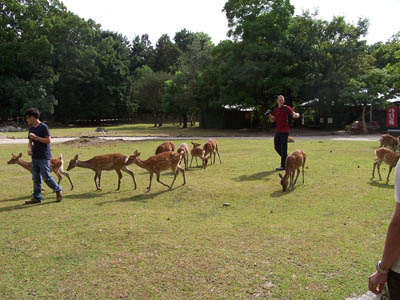 Amongst the Buddhist pagodas and the trees and the lakes is a huge gang of deer. They are tame by deer standards, and also rather bold. Tourists with maps in the back pocket of their jeans soon discovered how it felt to have a deer’s teeth dig in to the flesh of their bum cheek. The problem is so pronounced that the authorities felt the need to put up warning signs:
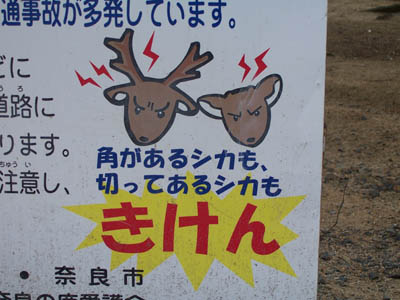
Sadly I never saw any deer fire red lightning from their heads. That would have been brilliant.
Make your way further uphill through Nara’s park, take a few left turns and with a bit of luck you’ll be able to find the largest wooden structure in the world:
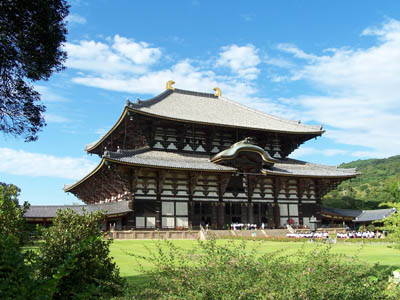
Those little white dots? Yeah, they’re people.
This is the Tōdai-ji. It is a huge and very old Buddhist temple. It is one of the main reasons that people visit Nara.
Maintaining a huge structure like this will cost a lot of money, especially when it’s made out of something as susceptible to the elements as wood. With this in mind, I didn’t begrudge paying the 500 Yen (around £2 or £3) to see it up close.
Pictures don’t do it justice. The scale is breathtaking, the lawn is immaculate, the setting is perfect.
As I stepped inside, past the gangs of schoolkids trying to practice their English on me (which was, incidentally, far better than my Japanese; ignorant gaijin) I was met with some very large sculptures:
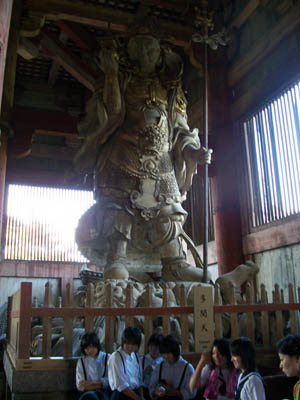 This wasn’t my camera’s finest hour. This statue is of some sort of warrior figure, I believe.
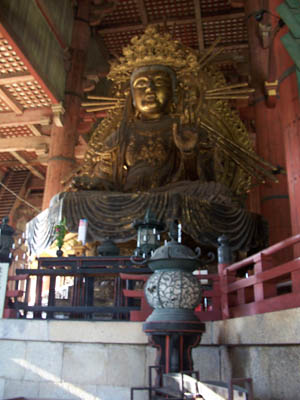
Imagine how much cash4gold.com would give you for all of this. I estimate that it would be around £261.
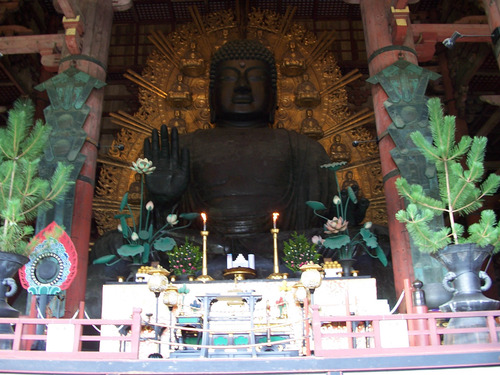
Big Buddha is watching you.
It was impossible to go in there and not feel small. Especially when you’re stood next to the Big Buddha. But imagine how much smaller I felt when I discovered that the Big Buddha had its own VIP area:
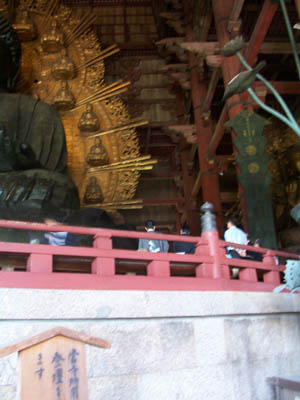
They must have been really good in a past life to be reincarnated as rich men.
Yep. There was a whole area cordoned off around the big Buddha that the public weren’t allowed to enter, but these nicely suited gentlemen were being showed around it by an enthusiastic looking guide. They looked to be paying tribute at the shrine, and no doubt contributed a good sum of money for the privilege. All that stuff about Buddhism treating all as equals rang very hollow that day.
This wasn’t all. The gift shop, complete with the usual seaside tat sold at most heritage sites, also had this sign:
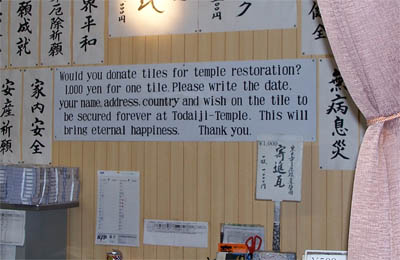
For around £5, you could pay for a tile to ensure the temple’s upkeep. Fair enough. But promising eternal happiness? Not just a fleeting moment’s happiness, but eternal happiness? Not just happiness that lasts until your knackered toaster burns one side of your bread, but eternal happiness? This means that they’re selling the opportunity for you to be happy for every single moment until you breathe your last, and even then the preceding eternity can’t wipe that smug grin off of your face. And all this for a fiver? Wow. And I thought The Armando Iannucci Shows for six quid was a good deal.
I appreciate the need to maintain this important cultural artefact, and the large sums of money needed to do this. But promising eternal happiness? How dare they? How bloody dare they? They don’t have the faculty to give this and they damn well know it. And to offer it to someone for a sum of money, however small, is beyond reproach.
I’d have come away with a lot more respect for the temple had it just asked for donations for its upkeep. But, like many other religions have been known to, it offered a fast track to salvation in exchange for cash.
For all its talk of eschewing worldly possessions, this temple sure knows how to chase the Yen. While the building and its sculptures left me speechless, the cosying up to the rich and the empty promises of happiness for cash left a very sour taste in my mouth.