Ask most people about George Orwell and they’ll probably mention Animal Farm and Nineteen Eighty Four. Some might also be familiar with Down and Out in Paris and London and Keep the Aspidistra Flying. If anyone says ‘oh yeah, wasn’t George Orwell in Big Brother one year?’, please punch them in the gut. Hard.
When I was sixteen, Orwell was my favourite author. The sense of injustice, forced compromise and alienation that runs through his work appealed to my teenage angst. But this was not just wallowing material; his work is thoughtful and incisive. It was upon reading 1984 and Animal Farm that I put down the Che Guevara t-shirt, ditched the revolutionary socialism ethos, and started thinking about a more considered political stance.
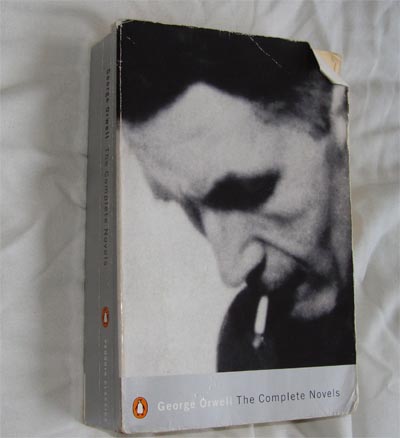
As you can see, my copy of George Orwell: The Complete Novels is well travelled:
 But since my second year of uni, I haven’t opened it once.
And then, just like that, I decided to open it again last week. I chose to skip the well-known ones and read his first published novel, Burmese Days. More below the divide.
As Orwell was stationed as an Indian Imperial Policeman in Burma between 1922 and 1927, Burmese Days has some wonderfully evocative descriptions. However, it doesn’t just portray Burma as an oriental wonderland. The climate and the insects make Orwell’s Burma an unforgiving and oppressive place.
The novel is set during the decline of the British Empire in a backwater Burmese province. Much of it centers around the goings-on of an exclusive club for snobby Europeans. Strictly no ‘natives’ allowed (including those in the service of the Empire). Despite its exclusivity, it is little more than a shack. However, the Europeans attend in order to assert their prestige.
Enter U Po Kyin, a native magistrate who uses his cunning to further his position in life. He will do anything in his power to ruin those who stand in the way of his ultimate goal: to get elected into the Europeans’ club. No deed is off limits for him, for, as a Buddhist, he plans to build a number of pagodas toward the end of his life in order to atone for his doings. This fat little man, with sharp little teeth stained red by betel juice, is likened to a crocodile on various occasions. And, like a crocodile, he goes for his enemies’ weak spots. For me, he is one of the most memorable villains in literature.
The protagonist, John Flory (the narrative rarely calls him by his first name, often opting for just ‘Flory’), is a timber merchant. He is in his mid-thirties and has grown to hate his life in Burma. A lot of his time is spent trying not to offend his European counterparts, despite his secret hatred for them. His only true friend is the humble Doctor Veraswami. Visiting the doctor is one of the only things that brings Flory any joy, though the friendship is frowned upon by the Europeans because of the Doctor’s Indian heritage. Veraswami would love nothing more than to be elected to the club because of the prestige it would bring, but Flory is torn over the issue, not wishing to draw the ire of the very same Europeans that he despises.
The plot progesses. U Po Kyin decides to bring down Veraswami through rumour and slander, and Flory knows that his friend would be untouchable if he were elected to the club. But Flory hesitates on this, not wishing to stick his neck out for his only friend. A young girl arrives, a neice to one of the club members. Flory falls in love and tries to get her attentions, ultimately failing after coming close.
At nearly 400 pages, it is hard to do it justice here. It bears the marks of a first novel. The descriptions are a little more grandiose than most of Orwell’s work, and the narrative tends to make sweeping generalizations like ‘Painting is the only art that can be practised without either talent or hard work’ (I get the impression Orwell’s art teacher didn’t like him very much).
In spite of this, Burmese Days is Orwell at his best. It is bleakly pessimistic, but with good reason. Like most of Orwell’s novels, Burmese Days is about crushed hope and being an outsider. It is vastly critical of the ruling authority and almost every page is a masterclass in satire. It has its flaws, but I love it all the more because of them.
Should you get the chance, I recommend you take a look at this one. There is an e-text available here, but if like me you prefer print then a printed version is available on Amazon for under a fiver.